

If you’ve spent any time researching help for your Shopify store, you’ve noticed that “Shopify development agency” and “Shopify development company” get used almost interchangeably across search results, directories, and marketplace listings. A few sites draw a hard line between them. Most don’t bother. That inconsistency isn’t an accident, it reflects how the Shopify partner ecosystem actually evolved, and it’s worth understanding before you spend a budget based on a label alone.
This guide breaks down where the terms genuinely overlap, where they diverge in practice, what’s changed technically on Shopify’s platform that now affects who you should hire, and how to evaluate a partner on substance rather than terminology.
Why the Terminology Got Muddled in the First Place
Early in Shopify’s growth, most stores were small enough that one freelancer or a two-person shop could handle design, theme coding, and app setup end to end. As the platform matured — and especially after Shopify Plus opened the door to enterprise merchants, the work split into two distinct disciplines: the strategic, brand-facing side (positioning, UX, conversion design) and the deeply technical side (custom app development, API integrations, checkout architecture, performance engineering).
Rather than inventing new vocabulary, the market kept using “agency” and “company” loosely, and search behavior followed suit. Today, someone typing “Shopify development agency” into Google is often signaling they want a partner involved in strategy and design, while “Shopify development company” tends to signal someone who already knows what they want built and is evaluating technical delivery capability. Neither term is standardized, and plenty of teams — including full-service shops, operate across both models depending on the engagement.
What People Usually Mean by “Shopify Development Agency”
A Shopify development agency is generally structured around the client relationship and the business outcome, not just the codebase. That typically includes:
- Discovery and UX strategy before any build starts, understanding the customer journey, not just the feature list
- Custom theme design built on Shopify’s Online Store 2.0 architecture, using sections and blocks for a merchant-editable storefront
- Third-party app integrations — subscriptions, loyalty programs, reviews, email/SMS platforms like Klaviyo, and back-office connections to ERP or inventory systems
- Conversion rate optimization, A/B testing, and analytics instrumentation
- Ongoing iteration and support after launch, usually on a retainer
Agencies tend to be the right call when the project is bigger than “build the store”, a full brand launch, a platform migration, or a store where design, marketing, and development all need to move together rather than in sequence.
What People Usually Mean by “Shopify Development Company”
A Shopify development company is more often associated with execution depth: custom theme development, custom Shopify app builds, API and webhook integrations, performance tuning, and Shopify Plus configuration. The framing is more scoped, you bring defined requirements, and the team builds against them.
This isn’t a hard rule. Plenty of “companies” run strategy work, and plenty of “agencies” have deep engineering benches. But when someone searches this specific phrase, they’re frequently comparing technical capability, code quality, and delivery reliability first, and brand strategy second, often because they already have design or marketing handled internally.

Agency vs. Company: A Side-by-Side Comparison
| Shopify Development Agency | Shopify Development Company | |
|---|---|---|
| Primary focus | Strategy, design, and build combined | Technical build and execution |
| Best fit for | Full store launches, rebrands, platform migrations | Feature builds, custom apps, Plus configuration |
| Team structure | Strategists, designers, and developers | Primarily developers and engineers |
| Typical engagement model | Ongoing partnership, retainer-based | Defined scope, project-based |
| What you bring to the table | A business goal | A technical requirement |
| Where value is added | Positioning, UX, and marketing alignment | Code quality, performance, and platform depth |
In practice, this table describes two ends of a spectrum, not two separate industries. Most Shopify partners sit somewhere in the middle, and the right question isn’t “which label do they use”, it’s “which half of this spectrum does my project actually need.”
The Technical Shift That Now Makes This Decision Matter More
There’s a reason this decision carries more weight in 2026 than it did a few years ago: Shopify has completed its long-running deprecation of checkout.liquid. Customization of the Information, Shipping, and Payment steps moved to Checkout Extensibility back in August 2024, and the Thank You and Order Status pages followed in August 2025 for Plus merchants. Non-Plus stores on the Basic, Shopify, and Advanced plans had their own deadline, legacy checkout scripts and additional scripts on those plans stopped working in August 2026.
Alongside that, Shopify Scripts, the Ruby-based logic many Plus stores used for custom discounting, shipping rules, and cart behavior, is being phased out in favor of Shopify Functions, a sandboxed framework that survives platform upgrades instead of breaking with every Shopify release.
Why this matters for your hiring decision: any store still relying on old checkout customizations or Scripts needs a partner who understands Checkout UI Extensions, Shopify Functions, and Web Pixels for analytics, not just Liquid theming. This is squarely execution-focused, technically dense work, and it’s exactly the kind of project where a company-style, engineering-heavy partner tends to outperform a generalist agency. If your store hasn’t audited its checkout customizations against these deadlines yet, that audit should happen before any new design work begins, building a beautiful storefront on top of a checkout that’s already lost functionality is a wasted engagement either way.
How Pricing and Engagement Models Typically Differ
Pricing structures follow the same divide as the work itself, though exact numbers vary widely by scope, region, and team seniority:
- Agencies more often price in phases, discovery, design, build, launch, and a post-launch retainer, because the scope evolves as strategy work uncovers new requirements.
- Companies more often price against a fixed spec, a defined list of features, integrations, or a migration checklist, which tends to produce tighter estimates but less flexibility if requirements shift mid-project.
Neither model is inherently cheaper. A tightly scoped technical build can come in below a strategy-heavy agency engagement, but only if the requirements were genuinely complete before work started, which is rarely true for a brand-new store.
Questions to Ask Before You Choose
- Do you have a finished design, or do you need one built? Starting from a blank page points you toward agency-style strategy and design work.
- Is this a new store or a migration? Migrations from WooCommerce, Magento, or a custom platform demand deeper technical planning, data mapping, and QA than a standard build — and often benefit from a partner who has handled cross-platform ecommerce solutions before, not just Shopify-native builds.
- Are you on Shopify Plus, or planning to move to it? Plus stores need specific, current experience with Checkout Extensibility, Shopify Functions, and higher-volume architecture — ask for examples of recent Plus work, not just Shopify work in general.
- Will you need ongoing support after launch? Agencies are typically structured for retainer-based, continuous optimization. Companies may focus narrowly on delivery and handoff, with support offered separately.
- How will you drive traffic once the store is live? A technically flawless store with no organic visibility plan is an incomplete engagement — ask whether ecommerce SEO is part of the offering or needs to be sourced separately.
- What’s your internal capacity? If you already have a designer or marketer on staff, you may only need the technical build, pointing you toward a more execution-focused partner rather than a full agency engagement.
Red Flags to Watch For, Regardless of Label
- Vague answers about Checkout Extensibility or Shopify Functions. If a partner can’t clearly explain how they’d handle your checkout customization needs post-deprecation, they haven’t kept current with the platform.
- No examples of Online Store 2.0 theme architecture. Sections-everywhere, block-based themes are the current standard; a portfolio full of older, hard-coded themes suggests dated practices.
- Pricing with no scope document. Both agencies and companies should be able to show you what’s included, not just a number.
- No plan for post-launch ownership. Someone needs to be responsible for bug fixes, app conflicts, and Shopify’s frequent platform updates after go-live, get that in writing before you sign.
Matching the Partner to the Scenario
- Launching a brand-new store with no existing design system → lean agency: strategy, UX, and design carry the most weight here.
- Migrating an existing WooCommerce or Magento store to Shopify → a partner strong in both platforms matters; if you’re also weighing whether to stay on WooCommerce instead of migrating, get that comparison from a partner who builds both, not one with a bias toward the platform they sell.
- Adding custom functionality to an existing, well-designed store → lean company: this is scoped, technical work.
- Running Shopify Plus with legacy checkout customizations → prioritize Checkout Extensibility and Shopify Functions experience above all else.
- Ongoing growth, testing, and optimization → agencies with retainer models are typically built for this; a project-based technical shop usually isn’t.
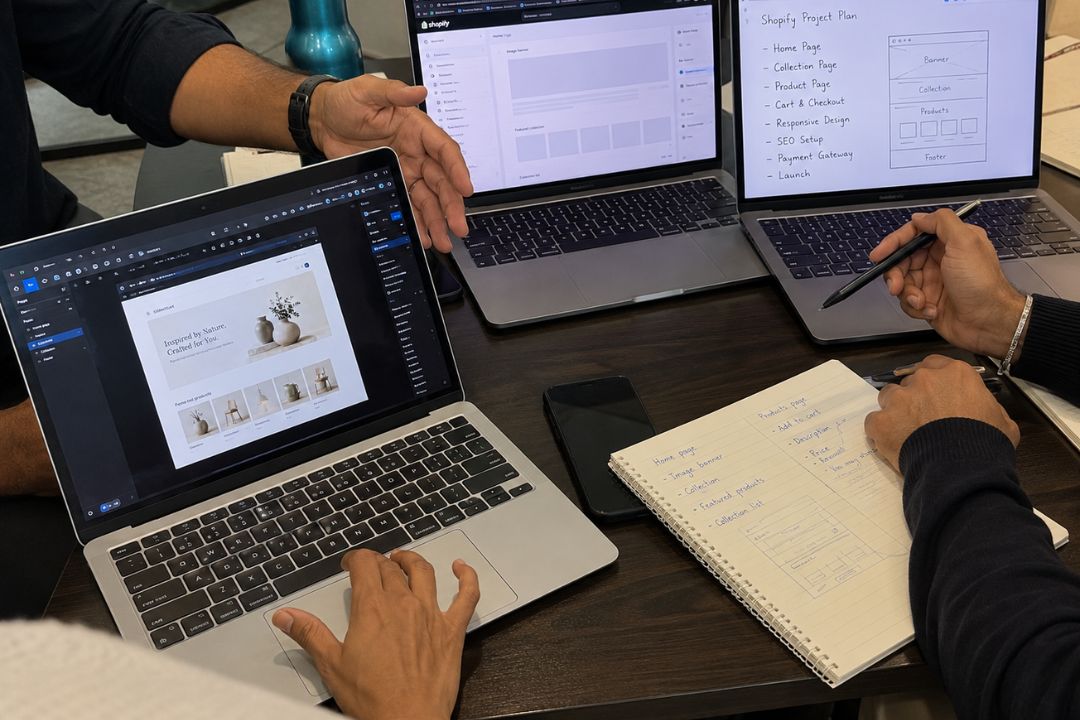
How Shivi Technologies Approaches Shopify Projects
We don’t force clients into one label or the other, because most real projects need both strategic and technical depth at different stages. Every engagement starts with a discovery conversation to determine whether you need full strategic support, focused technical execution, or, most commonly, a blend of both, and we build the team and scope around that answer rather than a fixed package.
Our Shopify development work covers custom theme development on Online Store 2.0, app and API integrations, Shopify Plus builds including Checkout Extensibility and Shopify Functions migrations, platform migrations from WooCommerce and other systems, and ongoing store optimization after launch.
Talk to our Shopify team about your project →